Watching my Red Sox, highest scoring offense in baseball, get completely shut down by the Indians pitching staff in the ALDS got me to thinking about their rotation. The Indians were without two of their best three starting pitchers, and still limited the Red Sox to 7 total runs in the three games. Granted, a big part of that was Andrew Miller (not a starter) whose existence allowed Terry Francona to twice pull the starting pitcher without facing the heart of the Red Sox lineup a third time.
But next season, the Indians will (presumably) have their entire rotation healthy, and that should scare the crap out of American League teams, especially in the Central. They will certainly be in the conversation for Best Rotation in Baseball. So the thought experiment I wanted to perform was to compare the projected Indians rotation with a rotation of the best pitchers from the rest of their division.
2017 Projected Indians Rotation (2017 Age, 2016 ERA, 2016 FIP)
Corey Kluber (31, 3.14, 3.26)
Carlos Carrasco (30, 3.32, 3.72)
Danny Salazar (27, 3.87, 3.74)
Trevor Bauer (26, 4.26, 3.99)
Mike Clevenger (26, 5.26, 4.86)
AL Central All-Star Rotation (2017 Age, 2016 ERA, 2016 FIP)
Chris Sale (28, 3.34, 3.46)
Justin Verlander (34, 3.04, 3.48)
Jose Quintana (28, 3.20, 3.56)
Michael Fulmer (24, 3.06, 3.76)
Danny Duffy (28, 3.51, 3.83)
Of course, Bauer and Clevenger are not locks for the rotation next season, but I would say they are probably the odds-on favorites, given Josh Tomlin's August meltdown. That said, I also wouldn't be surprised if Tomlin were to be in the rotation, with either Bauer or Clevenger serving as the long man.
My first four choices for the AL Central team were fairly easy: Sale, Verlander, Quintana, Fulmer. For the last spot, it's close between Duffy, Daniel Norris, and Yordano Ventura. Ventura is immensely talented with electric stuff, and Norris was a top prospect who really started to find a grove in August/September, so I wouldn't be opposed to picking either of them. But Duffy has been the most consistent out of the group, and had moments throughout the year where he looked like a legitimate #2 starter.
THE VERDICT: I would take the AL Central All-Star Rotation. But the fact that it is as close as it is highlights the immense collection of talent that the Indians have in their rotation.
The comparison I looked at here is just for the 2017 season. But maybe a more realistic way to look at it is considering all the seasons after 2016, like a GM would. In that scenario, you might drop Verlander and Duffy from the rotation to add in Norris and maybe even Jose Berrios of the Twins. This would tip the balance even more away from the Indians-only rotation, but that is to be expected.
All stats are courtesy of Fangraphs.com.
Wednesday, October 12, 2016

Monday, October 10, 2016
Who SHOULD your team's AAA-affiliate be?
For a variety of different reasons, hardcore baseball fans have a certain affinity for their team's AAA-affiliate. Prospect-hounds love to watch top prospects progress through the minor league system and AAA is often the last test before they are promoted to the major league team. When players get injured, they will play rehab games with the minor league teams, which gives us another reason to be aware of exactly where the affiliate is.
But one thing that isn't necessarily thought about much, except on rare occasions, is the distance between the big league team and the AAA-affiliate. Your starter has a freak injury in the morning, and you need an emergency call-up to start the game? It's a lot easier to get a pitcher up from AAA if you're Seattle, whose AAA-affiliate is just a short drive down I-5 to Tacoma. This is not quite the case for the New York Mets, who are over 2000 miles away from their highest minor league affiliate in Las Vegas.
So what I wanted to do is to look at this in an analytical way, and try to find the optimal affiliate for each team. First, I'll share the results, and then down below I'll show my methodology for those who are interested.
MLB Team New AAA Old AAA
Boston Pawtucket Pawtucket
NY Yankees Scranton Scranton
Baltimore Norfolk Norfolk
Tampa New Orleans Durham
Toronto Rochester Buffalo
CHW Indianapolis Charlotte
Detroit Toledo Toledo
Kansas City Oklahoma City Omaha
Cleveland Columbus Columbus
Minnesota Omaha Rochester
Texas El Paso Round Rock
Houston Round Rock Fresno
Seattle Tacoma Tacoma
Oakland Reno Nashville
LA Angels Salt Lake City Salt Lake City
Washington Durham Syracuse
NY Mets Syracuse Las Vegas
Miami Charlotte New Orleans
Atlanta Gwinnett Gwinnett
Philadelphia Lehigh Valley Lehigh Valley
CHC Nashville Iowa
St Louis Memphis Memphis
Pittsburgh Buffalo Indianapolis
Cincinnati Louisville Louisville
Milwaukee Iowa Colorado Springs
LA Dodgers Fresno Oklahoma City
San Francisco Sacramento Sacramento
San Diego Las Vegas El Paso
Arizona Albuquerque Reno
Colorado Colorado Springs Albuquerque
As you can see, there are 12 teams that get to keep their current affiliate, and 18 teams that would change affiliates under this method. Of the 18 teams that would change their affiliate, only 5 teams would have an increased travel distance, while the other 13 teams would decrease the travel distance. Only the Rangers would have a huge increase, moving from Round Rock to El Paso which is about a 417 mile increase. The Dodgers, Mets, A's, and Astros all get massive travel savings, especially the Mets who would no longer send their AAA players to Las Vegas, but rather to Syracuse.
The White Sox, Astros, Marlins, Pirates, Padres, and Rockies all get reunited with former AAA-affiliates. The Sky Sox and Rockies split ways only 2 years ago, after a 22-year player development relationship, but are probably the most obvious MLB-AAA geographic pairing that doesn't currently exist.
Also, with these new optimized MLB-AAA pairings, total travel distance between all 30 teams and their affiliates has been reduce by over 55%. Obviously travel distance isn't the most important factor that teams consider when negotiating new Player Development Contracts, but I imagine it would certainly be one of the considerations.
But one thing that isn't necessarily thought about much, except on rare occasions, is the distance between the big league team and the AAA-affiliate. Your starter has a freak injury in the morning, and you need an emergency call-up to start the game? It's a lot easier to get a pitcher up from AAA if you're Seattle, whose AAA-affiliate is just a short drive down I-5 to Tacoma. This is not quite the case for the New York Mets, who are over 2000 miles away from their highest minor league affiliate in Las Vegas.
So what I wanted to do is to look at this in an analytical way, and try to find the optimal affiliate for each team. First, I'll share the results, and then down below I'll show my methodology for those who are interested.
MLB Team New AAA Old AAA
Boston Pawtucket Pawtucket
NY Yankees Scranton Scranton
Baltimore Norfolk Norfolk
Tampa New Orleans Durham
Toronto Rochester Buffalo
CHW Indianapolis Charlotte
Detroit Toledo Toledo
Kansas City Oklahoma City Omaha
Cleveland Columbus Columbus
Minnesota Omaha Rochester
Texas El Paso Round Rock
Houston Round Rock Fresno
Seattle Tacoma Tacoma
Oakland Reno Nashville
LA Angels Salt Lake City Salt Lake City
Washington Durham Syracuse
NY Mets Syracuse Las Vegas
Miami Charlotte New Orleans
Atlanta Gwinnett Gwinnett
Philadelphia Lehigh Valley Lehigh Valley
CHC Nashville Iowa
St Louis Memphis Memphis
Pittsburgh Buffalo Indianapolis
Cincinnati Louisville Louisville
Milwaukee Iowa Colorado Springs
LA Dodgers Fresno Oklahoma City
San Francisco Sacramento Sacramento
San Diego Las Vegas El Paso
Arizona Albuquerque Reno
Colorado Colorado Springs Albuquerque
As you can see, there are 12 teams that get to keep their current affiliate, and 18 teams that would change affiliates under this method. Of the 18 teams that would change their affiliate, only 5 teams would have an increased travel distance, while the other 13 teams would decrease the travel distance. Only the Rangers would have a huge increase, moving from Round Rock to El Paso which is about a 417 mile increase. The Dodgers, Mets, A's, and Astros all get massive travel savings, especially the Mets who would no longer send their AAA players to Las Vegas, but rather to Syracuse.
The White Sox, Astros, Marlins, Pirates, Padres, and Rockies all get reunited with former AAA-affiliates. The Sky Sox and Rockies split ways only 2 years ago, after a 22-year player development relationship, but are probably the most obvious MLB-AAA geographic pairing that doesn't currently exist.
Also, with these new optimized MLB-AAA pairings, total travel distance between all 30 teams and their affiliates has been reduce by over 55%. Obviously travel distance isn't the most important factor that teams consider when negotiating new Player Development Contracts, but I imagine it would certainly be one of the considerations.
Methodology
My first challenge was to collect the data, which I did by using a simple online calculator for straight-line distances between cities. I didn't differentiate the Los Angeles, Chicago, New York, and Bay Area teams from one another, just to make the data collection a little quicker. The distances were put into a 30-by-30 matrix (Matrix #1), 900 MLB-to-AAA distances in total.
I then created two more matrices next to the original one, which would help me enter the problem into the optimization add-in OpenSolver. Matrix #2 was left blank by myself, but would be changed to either a 1 or 0 by OpenSolver. Matrix #3 simply multiplied the distance from Matrix #1 with the corresponding binary value from Matrix #2. I also created a column to sum each row in Matrix #2, a row to sum each column for Matrix #2, and a column to sum each row in Matrix #3. Finally, the summed column on Matrix #3 was itself summed together, which is the Target Cell to be minimized.
The OpenSolver optimization problem was set up as follows. The Target Cell (total distance of the selected 30 MLB-AAA pairings) is set to be minimized, with the following constraints:
- All 900 cells in Matrix #2 must be binary (1 or 0)
- The sum of every row (AAA team) in Matrix #2 must be exactly 1
- The sum of every column (MLB team) in Matrix #2 must be exactly 1
These constraints make sure that every AAA team and every MLB team has one and only one "1" input into the corresponding row/column. A "1" in Matrix #2 indicates that the MLB-AAA pairing has been selected, which then allows Matrix #3 to pull in the distance from Matrix #1 for only the cells with a "1" in Matrix #2.
Another variation of this analysis would be to add another constraint, requiring every selection to be less than 600 miles in distance, as to make sure no team gets unnecessarily screwed on travel just to benefit the league on the whole. Adding this into the problem changes the results, but only slightly. Atlanta and Miami would swap affiliates, since Gwinnett is the only AAA team within 600 miles of Miami, and Charlotte is the second-best option for Atlanta, making a perfect fit for a 1-for-1 swap. The overall total mileage is only increased by 131 miles, or 2%.
And there are many other ways in which the problem could be adjusted to satisfy certain conditions, but these are certainly the most relevant.
Tuesday, September 6, 2016
The Unholy Hot Streak of Brian Dozier
Living in the Twin Cities area for this year has made me slightly more tuned into the Twins this season. I've heard a lot more about the struggles of Byron Buxton, the starting rotation, and now that I think about it, the team as a whole. But what has set the town on fire since the All-Star break is diminutive second baseman Brian Dozier.
Now I would forgive you if you weren't paying much attention to Dozier's 2nd half stats, as the Twins are firmly out of the playoff picture, and their biggest star, Joe Mauer, is a shell of his former self. But brace yourself for the batting line you're about to witness:
50 G, 232 PA, 69 H, 16 2B, 24 HR, 48 RBI, .327/.372/.763/1.135
Paced out over 162 games it looks like this:
162 G, 752 PA, 224 H, 52 2B, 78 HR, 156 RBI, .327/.372/.763/1.135
Yes, you read that correctly. 78 FREAKING HOME RUNS. And this isn't a hot week or two, this is about one-third of an entire season. Even if you extend the period back to the past 72 games, he's still pacing 70 home runs over 162 games. Simply put, baseball rarely sees a hot streak that is this hot and for this long.
Dozier has a chance to hit both 40 HR and 40 2B this season, which has only been accomplished 38 times in baseball history. Most recently, both Josh Donaldson and Nolan Arenado did it last season. While it is much more of a long shot, Dozier does have a chance to reach 100 extra base hits (he is currently at 75).
Since 1941, there have only been 21 players with a 2nd half of at least 16 2B and 24 HR.The list is full of steroid-era players and future/current Hall of Famers. And then there is Brian Dozier. Every other player had at least 69 games to amass those totals. It's only taken Dozier 50 games.
The most home runs ever hit in a 2nd half is 1999 Mark McGwire with 37. 1938 Hank Greenberg and 1995 Albert Belle hit 36. 2001's Sammy Sosa and Barry Bonds hit 35 and 34, respectively. 2016 Brian Dozier is currently on pace to hit 35.5 home runs in the 2nd half. Just think about that company for a second.
Bottom line is, I'll have some of whatever Brian Dozier is having.
All statistics referenced are from Baseball-Reference.com.
Now I would forgive you if you weren't paying much attention to Dozier's 2nd half stats, as the Twins are firmly out of the playoff picture, and their biggest star, Joe Mauer, is a shell of his former self. But brace yourself for the batting line you're about to witness:
50 G, 232 PA, 69 H, 16 2B, 24 HR, 48 RBI, .327/.372/.763/1.135
Paced out over 162 games it looks like this:
162 G, 752 PA, 224 H, 52 2B, 78 HR, 156 RBI, .327/.372/.763/1.135
Yes, you read that correctly. 78 FREAKING HOME RUNS. And this isn't a hot week or two, this is about one-third of an entire season. Even if you extend the period back to the past 72 games, he's still pacing 70 home runs over 162 games. Simply put, baseball rarely sees a hot streak that is this hot and for this long.
Dozier has a chance to hit both 40 HR and 40 2B this season, which has only been accomplished 38 times in baseball history. Most recently, both Josh Donaldson and Nolan Arenado did it last season. While it is much more of a long shot, Dozier does have a chance to reach 100 extra base hits (he is currently at 75).
Since 1941, there have only been 21 players with a 2nd half of at least 16 2B and 24 HR.The list is full of steroid-era players and future/current Hall of Famers. And then there is Brian Dozier. Every other player had at least 69 games to amass those totals. It's only taken Dozier 50 games.
The most home runs ever hit in a 2nd half is 1999 Mark McGwire with 37. 1938 Hank Greenberg and 1995 Albert Belle hit 36. 2001's Sammy Sosa and Barry Bonds hit 35 and 34, respectively. 2016 Brian Dozier is currently on pace to hit 35.5 home runs in the 2nd half. Just think about that company for a second.
Bottom line is, I'll have some of whatever Brian Dozier is having.
All statistics referenced are from Baseball-Reference.com.
Wednesday, August 17, 2016
What Makes An MVP? AL MVP Race
Ahh, the classic baseball debate that begins to surface around this time of year. The MVP Award. In sports bars, living rooms, classrooms, online comment sections, you name it, there's going to be a debate of some sort about who deserves to be honored as The MVP. These arguments are (of course) not limited to the MVP; we love to argue over arbitrary rankings and lists of certain players, whether it be of this year, this generation, all-time, or anywhere in between.
Because of certain ambiguities, reasonable people can ask the same question, look at the same data, and come to completely different conclusions. What is the meaning of "valuable"? How much was Player X assisted by PEDs? Wherever we draw certain lines, there will always be that one player just barely on the outside who plenty would argue should be on the inside. Some are arbitrary heuristics; some are critical and meaningful definitions.
In this piece, I want to bring you through my thought process on the MVP award, why I think it is the correct way at looking at the award, but also why I think it is wrong to use this thinking at other times.
The Thought Process
My thought process when looking at MVP voting (and Cy Young voting for that matter) boils down to essentially a 3-way blend of WAR (Wins Above Replacement), WPA (Win Probability Added), and narrative. When talking about which teams or players will be the best for NEXT year, I firmly believe that WAR is far and away the best evaluation method. But we're not talking about next year; we're talking about the year that has just past, so the context of production is equally important to the raw numbers. While there is very little to suggest that clutch hitting is a verifiable, repeatable skill that some possess and others lack, it still has an impact on the games won and lost.
I think the narrative aspect is important to every evaluation from the outside looking in, because at the end of the day, we are human, the players are human, and the coaches are human. Part of what makes all sports so captivating is that we create narratives and expectations, so we shouldn't make these awards a simple calculation, because that takes away the human experience.
AL MVP Race
Honorable Mentions: Evan Longoria, Adrian Beltre, Robinson Cano, Miguel Cabrera, Adam Eaton, Jackie Bradley Jr.
10. Xander Bogaerts (Red Sox/SS) AL WAR Ranking: 13th AL WPA Ranking: 13th
Xander Bogaerts burst onto the scene in 2013. He signed in 2009 for a relatively modest $400,000, didn't appear on any top 100 prospect lists for 3 years, and then suddenly exploded all the way up to starting in the 2013 World Series and top prospect status. Since then, though, it seems like his shine has faded. In 2014 he was barely a replacement level player, which caused many people to write him off, despite being 21 years old. All he's done since then is consistently improve in every area of his game.
But maybe the craziest thing is that he's only the 4th best SS in the AL under the age of 25. Think about that for a second. More to come on that below.
9. Ian Desmond (Rangers/CF) AL WAR Ranking: 15th AL WPA Ranking: 4th
It may seem like a lifetime ago, but it was only earlier this year that Ian Desmond was considered "damaged goods" by many in the industry. He had his worst or near-worst offensive season in 2015 by any measure, and was going into his age-30 season. Few believed that he could regain his 3-time silver slugger form, and all teams that were looking to invest in a veteran were already set at SS.
So he changed. In one off-season, he became a center fielder, a position that he had played a combined 8 innings as a professional. No one would mistake him for Kevin Pillar or Kevin Kiermaier, but he has more than held his own. What sets him apart, though, is his return to form at the plate. He's almost the identical offensive player he was from 2012-2014, with the added bonus of being 4th in the AL in WPA.
8. Mookie Betts (Red Sox/RF) AL WAR Ranking: 4th AL WPA Ranking: 20th
This is the first obvious point where a player's place on the "Best Player in the League" list is very different from where he is in the MVP race. 2016 Mookie Betts is 2011 Andrew McCutchen, except for Betts being a better baserunner, a better fielder, a more powerful and consistent hitter, AND a year younger. Of course, we know what McCutchen became over the next few years, and have no idea of where Betts will go, but he's off to a pretty good start. The reason he's 8th here as opposed to top-5 is purely WPA. His best performances just haven't come in the closest games. That has nothing to do with his ability going forward, but it is reality. There's a good chance he'll be higher on this list by season's end.
7. Francisco Lindor (Indians/SS) AL WAR Ranking: 6th AL WPA Ranking: 21st
Francisco Lindor has been considered a top prospect from the moment he was drafted 8th overall in 2011. This was always because of his glove, which was so obviously superior, that it was easy to see him playing in the majors. Even if he never developed into a top quality hitter, his glove would keep him in the lineup everyday. But then something clicked when he reached the majors last year. He began to hit.
He has a higher OPS in the majors at 21 and 22 years old than he did at any level of the minors. He eclipsed his minor league HR total in in fewer than half of the at bats. He's been an above average hitter since he arrived -- not above average for shortstops, above average for the entire league. Oh and everything they said about his glove? That's all true too. There's even a name for it: The Francisco Lindor Effect.
6. Carlos Correa (Astros/SS) AL WAR Ranking: 9th AL WPA Ranking: 6th
Since Correa was the sneaky, not-Mike-Trout preseason MVP pick by many pundits, 6th might seem like a let down, but I'm here to tell you that it's not. He's the youngest player on this list, a dynamic hitter with obvious room for growth still, and hasn't actually gotten any worse from last season. His slash line is almost identical to last year's, slugging is a little down but on-base is a little up, and his defense is still above average at the most valuable defensive position. He's still as close to a lock as there is to win an MVP in the next decade.
5. David Ortiz (Red Sox/DH) AL WAR Ranking: 22nd AL WPA Ranking: 3rd
At age 40, David Ortiz is redefining the meaning of "going out on top." He's currently leading the league in doubles, SLG, and OPS, three categories that he's never lead the league in his entire career. He probably would have received a few 10th-place votes even if he had only been a shell of himself, but instead he decided to have the SINGLE GREATEST OFFENSIVE SEASON EVER by a player in his age 40 season, an honor currently held by Willie Mays. And of course he's 3rd in the AL in WPA. Because he's David Ortiz. Of course.
4. Manny Machado (Orioles/SS-3B) AL WAR Ranking: 5th AL WPA Ranking: 7th
Because of certain ambiguities, reasonable people can ask the same question, look at the same data, and come to completely different conclusions. What is the meaning of "valuable"? How much was Player X assisted by PEDs? Wherever we draw certain lines, there will always be that one player just barely on the outside who plenty would argue should be on the inside. Some are arbitrary heuristics; some are critical and meaningful definitions.
In this piece, I want to bring you through my thought process on the MVP award, why I think it is the correct way at looking at the award, but also why I think it is wrong to use this thinking at other times.
The Thought Process
My thought process when looking at MVP voting (and Cy Young voting for that matter) boils down to essentially a 3-way blend of WAR (Wins Above Replacement), WPA (Win Probability Added), and narrative. When talking about which teams or players will be the best for NEXT year, I firmly believe that WAR is far and away the best evaluation method. But we're not talking about next year; we're talking about the year that has just past, so the context of production is equally important to the raw numbers. While there is very little to suggest that clutch hitting is a verifiable, repeatable skill that some possess and others lack, it still has an impact on the games won and lost.
I think the narrative aspect is important to every evaluation from the outside looking in, because at the end of the day, we are human, the players are human, and the coaches are human. Part of what makes all sports so captivating is that we create narratives and expectations, so we shouldn't make these awards a simple calculation, because that takes away the human experience.
AL MVP Race
Honorable Mentions: Evan Longoria, Adrian Beltre, Robinson Cano, Miguel Cabrera, Adam Eaton, Jackie Bradley Jr.
10. Xander Bogaerts (Red Sox/SS) AL WAR Ranking: 13th AL WPA Ranking: 13th
Xander Bogaerts burst onto the scene in 2013. He signed in 2009 for a relatively modest $400,000, didn't appear on any top 100 prospect lists for 3 years, and then suddenly exploded all the way up to starting in the 2013 World Series and top prospect status. Since then, though, it seems like his shine has faded. In 2014 he was barely a replacement level player, which caused many people to write him off, despite being 21 years old. All he's done since then is consistently improve in every area of his game.
But maybe the craziest thing is that he's only the 4th best SS in the AL under the age of 25. Think about that for a second. More to come on that below.
9. Ian Desmond (Rangers/CF) AL WAR Ranking: 15th AL WPA Ranking: 4th
It may seem like a lifetime ago, but it was only earlier this year that Ian Desmond was considered "damaged goods" by many in the industry. He had his worst or near-worst offensive season in 2015 by any measure, and was going into his age-30 season. Few believed that he could regain his 3-time silver slugger form, and all teams that were looking to invest in a veteran were already set at SS.
So he changed. In one off-season, he became a center fielder, a position that he had played a combined 8 innings as a professional. No one would mistake him for Kevin Pillar or Kevin Kiermaier, but he has more than held his own. What sets him apart, though, is his return to form at the plate. He's almost the identical offensive player he was from 2012-2014, with the added bonus of being 4th in the AL in WPA.
8. Mookie Betts (Red Sox/RF) AL WAR Ranking: 4th AL WPA Ranking: 20th
This is the first obvious point where a player's place on the "Best Player in the League" list is very different from where he is in the MVP race. 2016 Mookie Betts is 2011 Andrew McCutchen, except for Betts being a better baserunner, a better fielder, a more powerful and consistent hitter, AND a year younger. Of course, we know what McCutchen became over the next few years, and have no idea of where Betts will go, but he's off to a pretty good start. The reason he's 8th here as opposed to top-5 is purely WPA. His best performances just haven't come in the closest games. That has nothing to do with his ability going forward, but it is reality. There's a good chance he'll be higher on this list by season's end.
7. Francisco Lindor (Indians/SS) AL WAR Ranking: 6th AL WPA Ranking: 21st
Francisco Lindor has been considered a top prospect from the moment he was drafted 8th overall in 2011. This was always because of his glove, which was so obviously superior, that it was easy to see him playing in the majors. Even if he never developed into a top quality hitter, his glove would keep him in the lineup everyday. But then something clicked when he reached the majors last year. He began to hit.
He has a higher OPS in the majors at 21 and 22 years old than he did at any level of the minors. He eclipsed his minor league HR total in in fewer than half of the at bats. He's been an above average hitter since he arrived -- not above average for shortstops, above average for the entire league. Oh and everything they said about his glove? That's all true too. There's even a name for it: The Francisco Lindor Effect.
6. Carlos Correa (Astros/SS) AL WAR Ranking: 9th AL WPA Ranking: 6th
Since Correa was the sneaky, not-Mike-Trout preseason MVP pick by many pundits, 6th might seem like a let down, but I'm here to tell you that it's not. He's the youngest player on this list, a dynamic hitter with obvious room for growth still, and hasn't actually gotten any worse from last season. His slash line is almost identical to last year's, slugging is a little down but on-base is a little up, and his defense is still above average at the most valuable defensive position. He's still as close to a lock as there is to win an MVP in the next decade.
5. David Ortiz (Red Sox/DH) AL WAR Ranking: 22nd AL WPA Ranking: 3rd
At age 40, David Ortiz is redefining the meaning of "going out on top." He's currently leading the league in doubles, SLG, and OPS, three categories that he's never lead the league in his entire career. He probably would have received a few 10th-place votes even if he had only been a shell of himself, but instead he decided to have the SINGLE GREATEST OFFENSIVE SEASON EVER by a player in his age 40 season, an honor currently held by Willie Mays. And of course he's 3rd in the AL in WPA. Because he's David Ortiz. Of course.
4. Manny Machado (Orioles/SS-3B) AL WAR Ranking: 5th AL WPA Ranking: 7th
Having made his debut about a month after his 20th birthday, Machado feels like a grizzled vet even though he just turned 24. He's in his 4th full season, and he has cemented himself into the annual MVP conversation. He finished 9th and 4th in the two seasons that he hasn't missed significant time due to injury. This year he's pretty much locked in another top-5 finish. In addition to an increase in offensive output for the 5th straight season, he's been asked to play significant time at SS. He was a full time SS as an amateur and minor leaguer, but this is the first time he's been asked as a big leaguer. Get used to seeing Machado up here with Correa for a decade.
3. Jose Altuve (Astros/2B) AL WAR Ranking: 3rd AL WPA Ranking: 9th
Altuve has been easily the best offensive 2B in baseball since 2014 when he led the league in hits, average, and stolen bases. Last year he led the AL in hits and stolen bases again. But this year has been something else. His offensive production is near the top league-wide, not just among second basemen. He's once again leading the league in hits and batting average, but now he's also leading the league in on-base and OPS+, while ranking 2nd in slugging (Ortiz).
The only knock against him? He's actually a bad base runner. He's often over-aggressive on the basepaths, getting thrown out trying to stretch out hits for an extra base. That's about the only downside to his game at this point, though.
The only knock against him? He's actually a bad base runner. He's often over-aggressive on the basepaths, getting thrown out trying to stretch out hits for an extra base. That's about the only downside to his game at this point, though.
2. Josh Donaldson (Blue Jays/3B) AL WAR Ranking: 2nd AL WPA Ranking: 2nd
It seems like Josh Donaldson has been underrated since he got called up to big leagues. It took him until he was 27 years old to get a full time role. Once he got that chance, he was immediately both a top defender and hitter at 3B. The Athletics, though, didn't seem to think he was going to be that valuable going forward, as he was traded for what looked like a paltry sum at the time. The return for him looks outright laughable now. Last year he maintained top level defense and improved his offensive production, leading the league in runs, RBIs, and total bases. And this year he has shown no signs of slowing down. The only difference between now and last year is that the Blue Jays had an insane close to the season, winning 69% of their games after the trade deadline. They didn't acquire a David Price this year at the deadline, so I doubt that will happen again.
1. Mike Trout (Angels/CF) AL WAR Ranking: 1st AL WPA Ranking: 1st
What is there to say about Mike Trout that hasn't been said already? At this point, I have no idea. For his age-20 through 23 seasons, he ranks 1st, 2nd, 10th, and 7th in WAR respectively all-time. So far this season he ranks 29th all-time for age-24 seasons. With a quarter of the season to go! He's on pace for another 10+ WAR season, which would put him in the top-7 all-time for age-24 seasons. I feel like we've already begun to take him for granted. He's one of the few players that anyone ever looks at and says "he has a chance to be the greatest of all time." Albert Pujols, Alex Rodriguez, and Barry Bonds are the only other recent players about whom you could begin to have that thought. Mike Trout is one of those players.
All statistics are from Fangraphs.com or Baseball-Reference.com
Sunday, January 24, 2016
Yoenis Cespedes's Contract is the Epidome of the Overall Trend
It has been happening more in recent years, but Friday's announcement that Yoenis Cespedes had agreed to a 3 year, $75 million deal to remain with the New York Mets. He was traded to the Mets at the trade deadline last year, and had an ideal right-before-free-agency performance. Paced out over 162 games, his stint with the Mets would have yielded 48 HR, 125 RBI, and a .287/.337/.604/.942 slash line with a 157 OPS+.
While nobody thought he would replicate that performance, conventional wisdom would indicate that he would receive AT LEAST 5 year, $100+ million contract. FanGraphs' Dave Cameron projected him to receive a 7 year, $150 million contract. Jim Bowden, former GM of the Reds and Nationals, had a more conservative projection of 6 year, $126 million contract. While there were many credible reports that he did receive a 5 year, $100 million contract from the Nationals, he ultimately turned down that contract to return to the Mets.
Now this is no ordinary contract. A decade or two ago, you would have assumed it would be an evenly-space or slightly backloaded deal. But this contract is FRONTloaded, with $27.5 million coming in the first year. Additionally, he has the option to rejoin free agency next year when there will be a significantly weaker group of outfielder free agents. More and more, teams and players are agreeing to contracts that are less straightforward, with multiple wrinkles that effects the years and money distribution of the contract.
Max Scherzer's contract was for 7 years, $210 million but paid out in $15 million increments for 14 years. Giancarlo Stanton's ridiculous 13 year, $325 million contract is insanely backloaded with an opt-out before the bulk of the money comes. The new deal that Chris Davis signed last week will pay him $17 million for the next seven years (the duration of his playing commitment) and then $4.2 million for the following 10 years.
These contracts and many others that have been signed in recent years have been stuffed full of opt-outs, deferrals, and ultra-specific incentive clauses that have created a significant increase in fan attention towards contract details. What has caused this shift in the way contracts are structured? There are two main factors that I see here.
First, I think that Major League Baseball players and their agents are becoming craftier with maximizing their compensation. Think about the deal that David Price signed with the Red Sox this season. Price will earn $30 million annually for the first three years, after which he can opt-out. If he is as good has he has been his whole career, he will probably opt-out and be able to get a deal for around $35 million annually after the 2018 season (considering inflation and continued revenue growth). In this scenario, the Red Sox only get him for three years. The other scenario is that he underperforms, in which he won't be able to get $30 million annually on the free agent market in 2018, so he will opt-in to the rest of his contract. If this happens, the Red Sox will be stuck with an aging player who is nowhere near worth the $31.75 million they will be paying him for the next four years.
Another factor is that owners and front offices are learning more about how players age and how risky they can be. Overpaying for a player for a near decade can be disastrous for your franchise. Overpaying for only 1-3 years, though, like the Mets may possibly be doing with Cespedes, will be tough but not a terrible burden long term. Rarely do teams get bailed out like the Dodgers did for Boston in 2012. Front offices are more aware of the fact that players often age faster than they would like, and have adopted the mentality that it is better to lose a player a year before he drops off than be stuck with him for a year too long.
These opposing forces have manifested in an increased complexity of players' contracts. It's rare that both sides will agree to a straight-up, equally spaced contract if the player will be older than 30 at any point in the deal. It seems like this will only increase in future years, and I predict that opt-outs will become the default for deals of three years or longer.
While nobody thought he would replicate that performance, conventional wisdom would indicate that he would receive AT LEAST 5 year, $100+ million contract. FanGraphs' Dave Cameron projected him to receive a 7 year, $150 million contract. Jim Bowden, former GM of the Reds and Nationals, had a more conservative projection of 6 year, $126 million contract. While there were many credible reports that he did receive a 5 year, $100 million contract from the Nationals, he ultimately turned down that contract to return to the Mets.
Now this is no ordinary contract. A decade or two ago, you would have assumed it would be an evenly-space or slightly backloaded deal. But this contract is FRONTloaded, with $27.5 million coming in the first year. Additionally, he has the option to rejoin free agency next year when there will be a significantly weaker group of outfielder free agents. More and more, teams and players are agreeing to contracts that are less straightforward, with multiple wrinkles that effects the years and money distribution of the contract.
Max Scherzer's contract was for 7 years, $210 million but paid out in $15 million increments for 14 years. Giancarlo Stanton's ridiculous 13 year, $325 million contract is insanely backloaded with an opt-out before the bulk of the money comes. The new deal that Chris Davis signed last week will pay him $17 million for the next seven years (the duration of his playing commitment) and then $4.2 million for the following 10 years.
These contracts and many others that have been signed in recent years have been stuffed full of opt-outs, deferrals, and ultra-specific incentive clauses that have created a significant increase in fan attention towards contract details. What has caused this shift in the way contracts are structured? There are two main factors that I see here.
First, I think that Major League Baseball players and their agents are becoming craftier with maximizing their compensation. Think about the deal that David Price signed with the Red Sox this season. Price will earn $30 million annually for the first three years, after which he can opt-out. If he is as good has he has been his whole career, he will probably opt-out and be able to get a deal for around $35 million annually after the 2018 season (considering inflation and continued revenue growth). In this scenario, the Red Sox only get him for three years. The other scenario is that he underperforms, in which he won't be able to get $30 million annually on the free agent market in 2018, so he will opt-in to the rest of his contract. If this happens, the Red Sox will be stuck with an aging player who is nowhere near worth the $31.75 million they will be paying him for the next four years.
Another factor is that owners and front offices are learning more about how players age and how risky they can be. Overpaying for a player for a near decade can be disastrous for your franchise. Overpaying for only 1-3 years, though, like the Mets may possibly be doing with Cespedes, will be tough but not a terrible burden long term. Rarely do teams get bailed out like the Dodgers did for Boston in 2012. Front offices are more aware of the fact that players often age faster than they would like, and have adopted the mentality that it is better to lose a player a year before he drops off than be stuck with him for a year too long.
These opposing forces have manifested in an increased complexity of players' contracts. It's rare that both sides will agree to a straight-up, equally spaced contract if the player will be older than 30 at any point in the deal. It seems like this will only increase in future years, and I predict that opt-outs will become the default for deals of three years or longer.
Monday, January 18, 2016
An (Actually) Modest Proposal for Universal DH
For my entire existence, the Designated Hitter has been the norm, not the exception. I grew up in an American League city, went to American League games, and, for a long time, just kind of assumed that the DH was how the game was played. Playing Little League didn't change that perception, despite the lack of DH, because the pitcher was usually one of the best hitters.
As I grew up and began talking to people with a wider variety of backgrounds, I soon realized that this was not reality for a lot of baseball fans. Many (mostly older) fans longed for the days without a DH, and claimed that it is a disgrace to not have the pitcher also bat. While I do understand the nostalgia that is invoked with the NL rules, I think it is pretty naive to think that Major League Baseball would ever get rid of the DH entirely.
In fact, in recent years, the idea of a universal DH rule has been gaining a lot of momentum. It seems inevitable at this point that the DH will be coming to the National League. It definitely won't be in 2016, probably not in 2017, but 2018 or 2019 would certainly be plausible, if not likely. While it seems like a straightforward proposition, to just have a DH instead of a pitcher, I think there is a better way. Let me lay out my plan, that I think would be interesting for traditionalists and modernists alike:
Just like in the American League currently, the DH-rule would be expanded to both leagues, but with an additional wrinkle. A team can select to NOT use the DH at the beginning of the game if they so choose. While it might seem like this would never be used, I could imagine the Giants or the Diamondbacks or the Cubs or the Marlins would consider it. If this option is chosen, the team has the option of re-implementing the DH at any point in the game. So let's say Madison Bumgarner is pitching AND hitting, and he is taken out for a reliever. Bruce Bochy would be able to designate a bench player to become the DH for the pitcher, OR he could have a current fielder become the DH and a bench player would replace him in the field. Once the DH has been put back in, traditional DH substitution rules go back into effect.
Would this option ever actually be used? It's hard to say. On one hand, nobody wants to see a pitcher get hurt swinging a bat or running the bases. On the other hand, there are a handful of pitchers who are MLB-quality hitters. In 2014, Madison Bumgarner was tied for the 4th highest OPS on the Giants. For his entire NL career, Zack Greinke has been an above replacement level hitter, including 2013 where he had an oWAR of 1.3 and the highest oWAR per 600 PA on the team (10.8).
My guess is that this option would hardly ever be used. Considering that the top pitchers are now making over $30mil per season, it would be hard for a manager to justify the risk to an owner. But it certainly adds the option and keeps some of the strategy for which traditionalists have bargained.
As I grew up and began talking to people with a wider variety of backgrounds, I soon realized that this was not reality for a lot of baseball fans. Many (mostly older) fans longed for the days without a DH, and claimed that it is a disgrace to not have the pitcher also bat. While I do understand the nostalgia that is invoked with the NL rules, I think it is pretty naive to think that Major League Baseball would ever get rid of the DH entirely.
In fact, in recent years, the idea of a universal DH rule has been gaining a lot of momentum. It seems inevitable at this point that the DH will be coming to the National League. It definitely won't be in 2016, probably not in 2017, but 2018 or 2019 would certainly be plausible, if not likely. While it seems like a straightforward proposition, to just have a DH instead of a pitcher, I think there is a better way. Let me lay out my plan, that I think would be interesting for traditionalists and modernists alike:
Just like in the American League currently, the DH-rule would be expanded to both leagues, but with an additional wrinkle. A team can select to NOT use the DH at the beginning of the game if they so choose. While it might seem like this would never be used, I could imagine the Giants or the Diamondbacks or the Cubs or the Marlins would consider it. If this option is chosen, the team has the option of re-implementing the DH at any point in the game. So let's say Madison Bumgarner is pitching AND hitting, and he is taken out for a reliever. Bruce Bochy would be able to designate a bench player to become the DH for the pitcher, OR he could have a current fielder become the DH and a bench player would replace him in the field. Once the DH has been put back in, traditional DH substitution rules go back into effect.
Would this option ever actually be used? It's hard to say. On one hand, nobody wants to see a pitcher get hurt swinging a bat or running the bases. On the other hand, there are a handful of pitchers who are MLB-quality hitters. In 2014, Madison Bumgarner was tied for the 4th highest OPS on the Giants. For his entire NL career, Zack Greinke has been an above replacement level hitter, including 2013 where he had an oWAR of 1.3 and the highest oWAR per 600 PA on the team (10.8).
My guess is that this option would hardly ever be used. Considering that the top pitchers are now making over $30mil per season, it would be hard for a manager to justify the risk to an owner. But it certainly adds the option and keeps some of the strategy for which traditionalists have bargained.
Sunday, April 13, 2014
What in hell's name is up with the Brewers?
The Milwaukee Brewers are the hottest team in baseball, and no one can stop them. After their 4-1 win over the Pirates this afternoon, their record sits at 10-2 with a current 9 game win streak. Where did this come from? They've scored 57 runs, while just letting up 29; that's almost twice as many runs scored as allowed! To what should we attribute this hot start? Let's break it down.
This is a man with a plan. After last year's (supposed) coming-out party, he looked ready to build off it with additional protection in the lineup. But he looks like a completely different player. Up until the beginning of this year, he had averaged less than 14 homers per 162 games. Then again, it happened to Granderson. It happened to Ellsbury. Could Gomez be next? Through twelve games in 2014, he is on pace for (an incredibly unrealistic) 54 homers. No one has hit more than that since Ryan Howard hit 58 in 2006. While his level of production is much higher than career norms, it is not unusual for someone of his profile to make a jump like this. Even more assuring is that he is actually hitting fewer balls in the air compared to his career average. Once that number comes back up, we may see even more big flies. Watch carefully, but an early MVP candidate if he can keep it up.
Another guy entering his prime with nothing to lose. 2012 was Lucroy's best year, but he only got 316 at bats that year thanks to a platoon with Martin Maldonado. When Lucroy took over the full-time role last year, everyone had high expectations. Unfortunately, his production fell across the board, and was a good (but not great, as everyone was hoping) catcher. This year he is proving everyone that believed in him throughout the 2013 season right, current posting what would be career highs in batting average, on-base, and slugging. Given his age, 28, it looks like this might also be legitimate improvement and here to stay.
Not really much surprise here. He has returned to pre-scandal form. His OBP is actually pretty low, so look for him to improve a little.
HERE is where it gets interesting. At 35 years old, Aramis is well over the hump, and would theoretically be worse this year. His OPS is 26 points higher and his batting average is an amazing 94 POINTS HIGHER than his career marks. This shouldn't continue, and if it does, critics everywhere will be shouting "steroids." Reynolds is a different story. Given a normal age curve, he should be in the prime of his career (he's only 3 months older than Braun). According to previous research, though, his "type," the single-dimensional slugger first-baseman, doesn't age well. This is quite a conundrum when trying to determine whether to buy or sell this early prduction. For both of these players, age seemed to be taking its toll, but maybe they both have a little left in the tank.
For pitching, I am going to group everyone together, because it's pretty easy to see what's going on. Pitchers are simply not letting runners on base. All five starting pitchers are putting up career lows in WHIP, and that statistic only has a year-to-year correlation of .442 (FanGraphs), meaning that only 44.2% of WHIP production is repeatable AKA skill-based. For a measure that is so closely linked to success to be highly based on random chance means that WHIP will fluctuate a great deal year-to-year. Bottom line: the Brewers' pitchers are getting lucky. It's not to say that this level of production will not continue. Only that it doesn't really mean they've all made leaps forward, and you shouldn't pick up every Brewers starting pitcher in your fantasy league.
Hitting
Carlos Gomez
This is a man with a plan. After last year's (supposed) coming-out party, he looked ready to build off it with additional protection in the lineup. But he looks like a completely different player. Up until the beginning of this year, he had averaged less than 14 homers per 162 games. Then again, it happened to Granderson. It happened to Ellsbury. Could Gomez be next? Through twelve games in 2014, he is on pace for (an incredibly unrealistic) 54 homers. No one has hit more than that since Ryan Howard hit 58 in 2006. While his level of production is much higher than career norms, it is not unusual for someone of his profile to make a jump like this. Even more assuring is that he is actually hitting fewer balls in the air compared to his career average. Once that number comes back up, we may see even more big flies. Watch carefully, but an early MVP candidate if he can keep it up.
Jonathan Lucroy
Another guy entering his prime with nothing to lose. 2012 was Lucroy's best year, but he only got 316 at bats that year thanks to a platoon with Martin Maldonado. When Lucroy took over the full-time role last year, everyone had high expectations. Unfortunately, his production fell across the board, and was a good (but not great, as everyone was hoping) catcher. This year he is proving everyone that believed in him throughout the 2013 season right, current posting what would be career highs in batting average, on-base, and slugging. Given his age, 28, it looks like this might also be legitimate improvement and here to stay.
Ryan Braun
Not really much surprise here. He has returned to pre-scandal form. His OBP is actually pretty low, so look for him to improve a little.
Mark Reynolds, Aramis Ramirez
HERE is where it gets interesting. At 35 years old, Aramis is well over the hump, and would theoretically be worse this year. His OPS is 26 points higher and his batting average is an amazing 94 POINTS HIGHER than his career marks. This shouldn't continue, and if it does, critics everywhere will be shouting "steroids." Reynolds is a different story. Given a normal age curve, he should be in the prime of his career (he's only 3 months older than Braun). According to previous research, though, his "type," the single-dimensional slugger first-baseman, doesn't age well. This is quite a conundrum when trying to determine whether to buy or sell this early prduction. For both of these players, age seemed to be taking its toll, but maybe they both have a little left in the tank.
Pitching
For pitching, I am going to group everyone together, because it's pretty easy to see what's going on. Pitchers are simply not letting runners on base. All five starting pitchers are putting up career lows in WHIP, and that statistic only has a year-to-year correlation of .442 (FanGraphs), meaning that only 44.2% of WHIP production is repeatable AKA skill-based. For a measure that is so closely linked to success to be highly based on random chance means that WHIP will fluctuate a great deal year-to-year. Bottom line: the Brewers' pitchers are getting lucky. It's not to say that this level of production will not continue. Only that it doesn't really mean they've all made leaps forward, and you shouldn't pick up every Brewers starting pitcher in your fantasy league.
Saturday, April 12, 2014
Better Late Than Never
So I guess it's been a while, hasn't it? I really haven't had the time to come on here and write, but I'm going to give it another go, and see if I can. This post is basically going to be a catch-up on what I have been doing for the past year, since I haven't been writing, and then we'll start some actual stuff next time.
Hey look! The text here looks a little different than the rest. I've been trying to learn HTML, CSS, and JavaScript in the past couple of weeks, but I will lay off it for the sake of your eyes. So far it is going alright, but it is a little intimidating. I figured I might as well try to add another weapon to my arsenal of skills.
I also went to the PBEO Job Fair at the Baseball Winter Meetings in Orlando last December. It was an amazing experience, where I got to meet so many people that are very important in the baseball world. Through there, I got a job working for a team during spring training and for the single-A team that plays there during the regular season. I plan on going this coming December when it will be in San Diego. I will be graduating around that time, so I will be looking for a full time job (so if you have a position open, let me know!).
I have been excelling in my classes this semester, and while it is not over, I think it might be my best semester yet in terms of grades. I have enjoyed my Business Intelligence and Analytics class as much, if not more than I though I would. Through that class, I have been able to finally confirm that I want to be a data analyst for a major league team. Most of the careers that I thought I wanted to do ended up being terrible fits for me, but I have finally found the perfect one (I think).
Well that's about it for now. I will try to write every day, but we all know how hard it is to do anything every day.
Friday, April 5, 2013
Game 3: Good, Not Great, Debut for Dempter
So the Red Sox finally lose a game. It took six months and a day, but the mighty Red Sox finally went down. I thought it might keep going, but then again, nothing lasts forever. Even the offseason.
What we saw was an OK Ryan Dempster with a stagnant offense. We won the previous game when letting up four runs, but the offense couldn't come through this time. I'll give props to the Yankees' pitchers last night, whose average age was 41.5 years old. I didn't know it was "Turn Back The Clock Night" at Yankee Stadium, but I guess Pettitte and Rivera had their own ideas. Lets just hope that this is a blip in the road, and the offense can keep producing at a high level for the rest of the season.
Dempster didn't really give us a clear idea of who he is going to be in Boston. Last year, with the Cubs, he was a great, bordering on elite, pitcher. When he switched over to the American League with the Rangers, he became a terrible, borderline Minor League, pitcher. Last night, he was kind of half way through. He gave up the lead early, but there was not too much bleeding after that.
What we saw was an OK Ryan Dempster with a stagnant offense. We won the previous game when letting up four runs, but the offense couldn't come through this time. I'll give props to the Yankees' pitchers last night, whose average age was 41.5 years old. I didn't know it was "Turn Back The Clock Night" at Yankee Stadium, but I guess Pettitte and Rivera had their own ideas. Lets just hope that this is a blip in the road, and the offense can keep producing at a high level for the rest of the season.
Dempster didn't really give us a clear idea of who he is going to be in Boston. Last year, with the Cubs, he was a great, bordering on elite, pitcher. When he switched over to the American League with the Rangers, he became a terrible, borderline Minor League, pitcher. Last night, he was kind of half way through. He gave up the lead early, but there was not too much bleeding after that.
Wednesday, April 3, 2013
Game 2: Jose Iglesias Quietly Shines Again
While it is obviously not a large sample size for the year, it looks like former "Shortstop of the Future" might be back to the current "Shortstop of the Future." After two impressive days in the field (as expected) and at the plate (very not expected), Jose Iglesias is looking like the player we thought he could possibly become.
Many thought (me included) that these first couple of days without Stephen Drew would feature stellar defense and a batting average between .050 and .100. But while it's not powerful, the contact is all there. He is 5 for 9 through two games, with four singles and a double. While it's unlikely he'll maintain a .556 batting average for the year, it looks like we may have underestimated Iglesias. As long as there is some offensive production, he is well worth it for the glove at short, and I would keep him in over a healthy Stephen Drew.
Many thought (me included) that these first couple of days without Stephen Drew would feature stellar defense and a batting average between .050 and .100. But while it's not powerful, the contact is all there. He is 5 for 9 through two games, with four singles and a double. While it's unlikely he'll maintain a .556 batting average for the year, it looks like we may have underestimated Iglesias. As long as there is some offensive production, he is well worth it for the glove at short, and I would keep him in over a healthy Stephen Drew.
Monday, April 1, 2013
Game 1: Starting the Season off Right
 The Boston Red Sox may not win the AL East this year, may not even make the playoffs, but you better start breaking out the sunglasses. "Why's that?" you may ask. Because the future looks bright. Very bright. Iglesias came through with a surprising three singles on his first opening day game. JBJ also came up big by getting on base twice, scoring once and driving in another. For an 8-9 combo with an average age of 22.5, I'd say that's alright. All in all, the Red Sox executed to perfection, and we came away with the first win on the season.
Thursday, February 21, 2013
Positional Rankings - 1B
This is a new outlook on the rankings that usually go on before a season starts. I want to look at who's the best of the best right now, who has the greatest potential to be part of that group, and who may have been part of that group at one point but is now falling off the table. I will call these groups "The Best," "The Next," and "The Fading."
The Best 5
1. Albert Pujols
2. Adrian Gonzalez
3. Prince Fielder
4. Joey Votto
5. Mark Teixiera
The top spot still belongs to Pujols, and will for a long time to come. Despite his advancing age, he remains the epitome of hard work and preparation. Also, if you don't know of his story, please check this out. You might have a good chuckle at your own team for missing him back in the day. Adrian Gonzalez is not going to relinquish his spot on this list just because one shaky year. He is still has the best glove at 1B, and even if his homerun numbers drop a little, he will always be an on-base machine. Fielder gets the third spot because he will put up massive numbers batting after the reining AL MVP. From his own mouth, Mark Teixeira's best years are almost behind him. Joey Votto, on the other hand, is only going up.
The Next 5
1. Chris Davis
2. Freddie Freeman
3. Mark Trumbo
4. Paul Goldschmidt
5. Anthony Rizzo
Last year was Chris Davis's coming out party, along with most of the Baltimore Orioles team. The reason I put him on the "next" list is because I still think he can do better. Freddie Freeman has teetered on the edge of greatness, but because of the other star power at 1B and with the Braves, hasn't totally broken out. Mark Trumbo is the same way for me. He's hit 61 homeruns in his first two seasons, but has been greatly overshadowed by the other stars on the Angels. Also, his position is with much uncertainty, so even though he will be the DH this year, I still put him here (because where else do I put him??). Goldschmidt gets looked over, I feel, because of where he plays, and maybe a little because of his name. A solid producer last year for the D-Backs, he has the potential to be a gold mine with 25-35 homeruns for the next 10 years. Ever since he was a farm hand with the Red Sox, he has been touted as the next greatest first baseman in the majors. And maybe the talk has been louder than the production to this point, but in only a half-season last year, he put up 15 HR with a .805 OPS. Look out for him to explode soon.
The Fading 5
1. Ryan Howard
2. Lyle Overbay
3. Lance Berkman
4. Paul Konerko
5. Adam Lind
It is really too bad about Ryan Howard. He won the Rookie of the Year and MVP in back to back years, and he was seemingly on the top of the world. Ever since then, though, he has been fading little by little from the upper echelons of baseball stardom. Though you can attribute last year's struggles to injury, that has to be a concern going forward. Now maybe it was just me, but it seems that Lyle Overbay just fell off the face of the earth all of a sudden until surfacing this offseason with the Red Sox. It was just in 2010 that he had his last 20 homerun season. Berkman's 2011 revival looks to be a fluke now. It was a nice story while it lasted, but this is probably his last season in baseball. The revival happened a year earlier for Paul Konerko, in 2010, but now it looks like he's on the steady fall down. Will still produce this year, but I would give him a max of 20 homeruns. Adam Lind's career appears to have been super accelerated. At the age of 26, he had a career year, finishing 15th in the MVP voting. For the three years following, though, he had an OPS+ in the 90's and hit a new low last year with only 11 homeruns. Oh yeah, he's still only 29. Hopefully he can fix something, but he may get overshadowed this year with all the new talent in Toronto.
The Best 5
1. Albert Pujols
2. Adrian Gonzalez
3. Prince Fielder
4. Joey Votto
5. Mark Teixiera
The top spot still belongs to Pujols, and will for a long time to come. Despite his advancing age, he remains the epitome of hard work and preparation. Also, if you don't know of his story, please check this out. You might have a good chuckle at your own team for missing him back in the day. Adrian Gonzalez is not going to relinquish his spot on this list just because one shaky year. He is still has the best glove at 1B, and even if his homerun numbers drop a little, he will always be an on-base machine. Fielder gets the third spot because he will put up massive numbers batting after the reining AL MVP. From his own mouth, Mark Teixeira's best years are almost behind him. Joey Votto, on the other hand, is only going up.
The Next 5
1. Chris Davis
2. Freddie Freeman
3. Mark Trumbo
4. Paul Goldschmidt
5. Anthony Rizzo
Last year was Chris Davis's coming out party, along with most of the Baltimore Orioles team. The reason I put him on the "next" list is because I still think he can do better. Freddie Freeman has teetered on the edge of greatness, but because of the other star power at 1B and with the Braves, hasn't totally broken out. Mark Trumbo is the same way for me. He's hit 61 homeruns in his first two seasons, but has been greatly overshadowed by the other stars on the Angels. Also, his position is with much uncertainty, so even though he will be the DH this year, I still put him here (because where else do I put him??). Goldschmidt gets looked over, I feel, because of where he plays, and maybe a little because of his name. A solid producer last year for the D-Backs, he has the potential to be a gold mine with 25-35 homeruns for the next 10 years. Ever since he was a farm hand with the Red Sox, he has been touted as the next greatest first baseman in the majors. And maybe the talk has been louder than the production to this point, but in only a half-season last year, he put up 15 HR with a .805 OPS. Look out for him to explode soon.
The Fading 5
1. Ryan Howard
2. Lyle Overbay
3. Lance Berkman
4. Paul Konerko
5. Adam Lind
It is really too bad about Ryan Howard. He won the Rookie of the Year and MVP in back to back years, and he was seemingly on the top of the world. Ever since then, though, he has been fading little by little from the upper echelons of baseball stardom. Though you can attribute last year's struggles to injury, that has to be a concern going forward. Now maybe it was just me, but it seems that Lyle Overbay just fell off the face of the earth all of a sudden until surfacing this offseason with the Red Sox. It was just in 2010 that he had his last 20 homerun season. Berkman's 2011 revival looks to be a fluke now. It was a nice story while it lasted, but this is probably his last season in baseball. The revival happened a year earlier for Paul Konerko, in 2010, but now it looks like he's on the steady fall down. Will still produce this year, but I would give him a max of 20 homeruns. Adam Lind's career appears to have been super accelerated. At the age of 26, he had a career year, finishing 15th in the MVP voting. For the three years following, though, he had an OPS+ in the 90's and hit a new low last year with only 11 homeruns. Oh yeah, he's still only 29. Hopefully he can fix something, but he may get overshadowed this year with all the new talent in Toronto.
Tuesday, February 19, 2013
Spring Fling: Preview
I will be spending much of my Spring Break following the Red Sox around, keeping you all up to date on the happenings and whatnot. While I am down there, I will have many questions and situations that I will be exploring in anticipation of the upcoming baseball season. If YOU have any questions you would like to be answered or looked into first-hand, please write them in the comments or shoot me a quick email.
Thursday, November 15, 2012
Josh Hamilton and the Red Sox
From many reports that have been surfacing recently, it appears that the Red Sox are in the thick of things when it comes to Josh Hamilton, Mr. Former MVP and Mr. Prime Free Agent of 2012/13. So far there have been two points indicating that he might could be headed to Beantown. First, the obvious one, there have been reports that Cherington has started regular contact with Hamilton's agent. Second, and a bit more telling, is GM Ben Cherington coming out and saying that the Red Sox will likely have one of the top payrolls in baseball. Considering that the Sox only have $45 million on the book so far for 2013, you have to think that they will make a huge splash somewhere. Pitcher Zach Greinke seems unlikely considering the recent troubles with big free-agent pitcher acquisitions. Whatever it is, I think that it is necessary that the Red Sox find a player that can help them contend again.
P.S. With the MVP voting coming out today, it is notable to say that no Sox player garnered a single MVP top-10 vote
P.S. With the MVP voting coming out today, it is notable to say that no Sox player garnered a single MVP top-10 vote
Monday, November 12, 2012
Immediate Reaction: Rookie of the Year
I don't think that the AL Rookie of the Year Award surprised anyone that has any sort of knowledge of baseball. The question wasn't really whether Mike Trout was the best rookie this year, but rather if he have the best season ever, in any sport. Now it is hard to compare cross-sport, to the seasons of Lawrence Taylor, Wilt Chamberlain, etc., so I will just compare it to the other great rookie seasons in baseball. One season that comes to mind is Ichiro, one of two players in MLB history to win MVP and ROY in the same season. This shouldn't have even happened though. To say that Ichiro was a rookie is a complete slap in the face to the NPB, because he played at the highest level available to him for a number of years, enduring the normal gruel of a regular season.
The only other player that really comes close is the other dual MVP/ROY ever, Fred Lynn. When it comes down to it, he really won the MVP because of a weak field that year. Nothing against Lynn's season, but it happened in a year where no one else was particularly spectacular. For me, Trout takes it. The level of talent he displayed at every facet of the game was incredible, and, in my mind, the best we have ever seen in a rookie year.
This season, though, Miguel Cabrera put on one of the most spectacular hitting displays ever seen in a single season. The vote that has yet to be tallied is whether the best hitting display, combined with average to above average displays in the other categories, outweighs a top-5 performance in every category imaginable.
The Rookie of the Year race in the NL was much more contested. Going into the unveiling, it was entirely conceivable that any of the three finalists could win the award. The final voting was close as well, but there were little signs that indicated it really wasn't. Bryce Harper was the only player named on all 32 ballots. He received the most 1st place votes, Wade Miley received the most 2nd place votes, and Todd Fraizer received the most 3rd place votes. Despite the hubbub around this race, the votes played out very normally. In the "disaster" scenario some were predicting, Harper might have received 20 first place votes, but only been named on 24 ballots. That, of course, did not happen, and justice was served. In my opinion, the best two rookies won their respective rookie of the year awards.
The only other player that really comes close is the other dual MVP/ROY ever, Fred Lynn. When it comes down to it, he really won the MVP because of a weak field that year. Nothing against Lynn's season, but it happened in a year where no one else was particularly spectacular. For me, Trout takes it. The level of talent he displayed at every facet of the game was incredible, and, in my mind, the best we have ever seen in a rookie year.
This season, though, Miguel Cabrera put on one of the most spectacular hitting displays ever seen in a single season. The vote that has yet to be tallied is whether the best hitting display, combined with average to above average displays in the other categories, outweighs a top-5 performance in every category imaginable.
The Rookie of the Year race in the NL was much more contested. Going into the unveiling, it was entirely conceivable that any of the three finalists could win the award. The final voting was close as well, but there were little signs that indicated it really wasn't. Bryce Harper was the only player named on all 32 ballots. He received the most 1st place votes, Wade Miley received the most 2nd place votes, and Todd Fraizer received the most 3rd place votes. Despite the hubbub around this race, the votes played out very normally. In the "disaster" scenario some were predicting, Harper might have received 20 first place votes, but only been named on 24 ballots. That, of course, did not happen, and justice was served. In my opinion, the best two rookies won their respective rookie of the year awards.
Monday, November 5, 2012
Going Retro
 It looks like we officially have a trend in baseball, at least with regards to the fashion worn on the field. On Friday, the Houston Astros unveiled their "new" logos to the fans, and I approve. Generally, I am on the positive side when it comes to fashion-forward uniforms, such as the many variations of the Oregon Ducks' football uniforms or the NFL's and NBA's obsession with replacing everything white on a jersey with black. Baseball has found a new way to make a fashion statement: go retro.
I guess the trend officially started last season when both the Orioles and the Blue Jays decided to revisit the glory days and remodel their logos after when they were most successful. For the Jays, it was the 1992-93 seasons, the only times they have appeared in (and won) a world series, along with the last time they even won the AL East. The Orioles returned to the cartoon bird, which brings back a time when they won their last AL pennant and world series (1983).
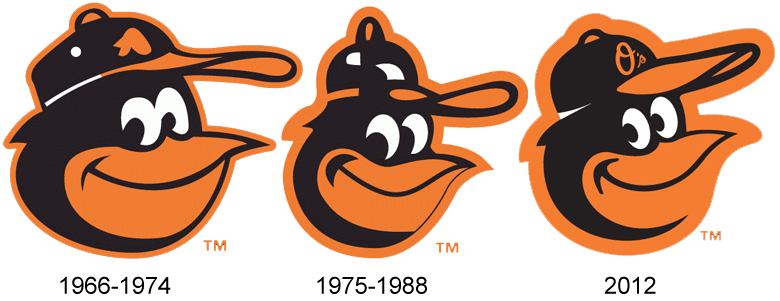
For the O's, the move was a clear success. By moving away from the design that hung over them during the worst years in franchise history, it was easy for the baseball world to love them again. A younger, spunkier team with a fun logo makes everyone want to hop on board the bandwagon.
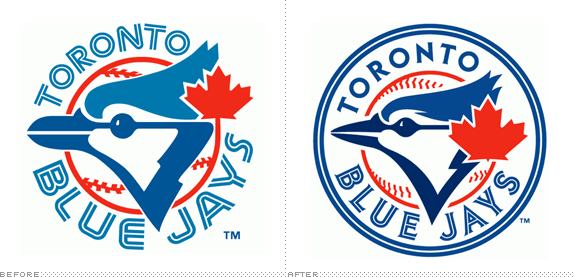 The Blue Jays had considerably less success, finishing the season with 89 wins, barely enough to not be in last place. They had shown a small spark the year before, which, much like the Orioles, probably triggered the move to the new logo. Unfortunately, the Blue Jays will have to wait their turn, as the AL East is still the toughest division in baseball.
Overall, I am really impressed with the changes. Making something new and different isn't always the way to go, and I'm glad that going back has worked for a few organization.
Sunday, November 4, 2012
AWARD PREDICTION: NL Rookie of the Year Edition
The race for the NL ROY is much close than the American League contest. There are three candidates that most of the media has anointed as frontrunners, and a few more that lurk very close behind. Depending on which statistics or metrics or viewpoints you use, a whole host of players could be your favorite. Let's look into the candidates that might be getting some votes:
Todd Frazier
.273 AVG, 19 HR, 67 RBI, 26 2B, .829 OPS
One of the key frontrunners that I wouldn't be surprised if he won, Frazier was one of the key cogs that led the Reds to an NL Central championship. When Scott Rolen went down, and later Joey Voto, he stepped right in and kept the Big Red Machine truckin' on. Overall, he might have had the most quality offensive performance by a rookie, but it was a very quiet quality and awards like this are about the excitement of a player in his first year lighting it up with the best in the business, and he didn't really provide that.
Wilin Rosario
.270 AVG, 28 HR, 71 RBI, 19 2B, .843 OPS
Rosario had an even quieter campaign than Frazier, mostly because of his small-market Rockies that didn't come within shouting distance of the playoffs. At 23-years-old, he already appears to be one of the best offensive catchers in the majors, up there with the likes of Posey, Mauer, and Molina. It's too bad that there are three clear cut leaders in this race, because he does deserve a few votes.
Anthony Rizzo
.285 AVG, 15 HR, 48 RBI, 15 2B, .805 OPS
Rizzo was a steal for the Cubs, who got him for relief pitchers Andrew Cashner before the 2012 season. A highly touted prospect in the Red Sox organization, he quickly blossomed with the Cubs once he got his chance. He played less than half of the season, which will certainly hurt him a lot, but it won't hurt him down the road when future homerun leaders are up for grabs.
Wade Miley
16-11, 3.33 ERA, 144 K, 37 BB, 194.2 IP
While he didn't lead his Diamondbacks to the playoffs, that is not as important to this award as it is for the MVP and Cy Young awards. Putting up a 3.33 is impressive regardless of age, but it did take place in the NL West (possibly the weakest division in baseball). Despite his relatively easy season, I feel that this is where the writers will lean towards, as 4 of the last 6 ROY winners have been pitchers.
Bryce Harper
Todd Frazier
.273 AVG, 19 HR, 67 RBI, 26 2B, .829 OPS
One of the key frontrunners that I wouldn't be surprised if he won, Frazier was one of the key cogs that led the Reds to an NL Central championship. When Scott Rolen went down, and later Joey Voto, he stepped right in and kept the Big Red Machine truckin' on. Overall, he might have had the most quality offensive performance by a rookie, but it was a very quiet quality and awards like this are about the excitement of a player in his first year lighting it up with the best in the business, and he didn't really provide that.
Wilin Rosario
.270 AVG, 28 HR, 71 RBI, 19 2B, .843 OPS
Rosario had an even quieter campaign than Frazier, mostly because of his small-market Rockies that didn't come within shouting distance of the playoffs. At 23-years-old, he already appears to be one of the best offensive catchers in the majors, up there with the likes of Posey, Mauer, and Molina. It's too bad that there are three clear cut leaders in this race, because he does deserve a few votes.
Anthony Rizzo
.285 AVG, 15 HR, 48 RBI, 15 2B, .805 OPS
Rizzo was a steal for the Cubs, who got him for relief pitchers Andrew Cashner before the 2012 season. A highly touted prospect in the Red Sox organization, he quickly blossomed with the Cubs once he got his chance. He played less than half of the season, which will certainly hurt him a lot, but it won't hurt him down the road when future homerun leaders are up for grabs.
Wade Miley
16-11, 3.33 ERA, 144 K, 37 BB, 194.2 IP
While he didn't lead his Diamondbacks to the playoffs, that is not as important to this award as it is for the MVP and Cy Young awards. Putting up a 3.33 is impressive regardless of age, but it did take place in the NL West (possibly the weakest division in baseball). Despite his relatively easy season, I feel that this is where the writers will lean towards, as 4 of the last 6 ROY winners have been pitchers.
Bryce Harper
.270 AVG, 22 HR, 59 RBI, 26 2B, 9 3B, 18 SB, .817 OPS
This would be my vote for NL Rookie of the Year, and it wouldn't even be close. Now, a lot of people will criticizing me for being lazy, but hear me out. His stats may not jump off of the page as being above and away better than his competitor, but I ask you to use the eye test. And if you use the eye test, I don't see how you could possibly dismiss him as all hype. He plays the game in a pure, dirt-and-grime, hard-nosed way. His value in the outfield is measureless; whenever there is a ball hit to the gaps, regardless of how hard, it is never a guaranteed hit. With everything he does on the field, I want to watch it over and over and just marvel at how he plays with such passion and heart. The hype isn't undeserved either, as many people have said. There is a reason he was on the cover of Sports Illustrated at 15-years-old: he is an electrifying player that turns heads with every play he makes.
Bryce Harper for NL Rookie of the Year
Pedro to Return to the Red Sox Organization
According to reports, a standing offer has been made to former Red Sox great Pedro Martinez to rejoin the team as a special consultant. Much like Jason Varitek's current role, Martinez would serve mostly as an advisor to GM Ben Cherington. "[Martinez] knows there is a role waiting for him when the time is right," Cherington says. The hope, presumably, is that once Pedro learns the ins an outs of the organization, he will be installed as a coach.
Varitek was one of the long-shots for the managerial job before the trade was made for John Farrell. After serving within the organization's front office, he seems to have embraced the off-the-field aspect of the game. Hopefully, if Martinez accepts the offer, he can go through the same motions and will join the Red Sox as a coach down the road.
Varitek was one of the long-shots for the managerial job before the trade was made for John Farrell. After serving within the organization's front office, he seems to have embraced the off-the-field aspect of the game. Hopefully, if Martinez accepts the offer, he can go through the same motions and will join the Red Sox as a coach down the road.
Friday, November 2, 2012
The New Era of Baseball
As we continue to move away from the troubling Steroid Era, we are looking for something to replace it. We as humans feel the need to label everything, and thus we're looking for the next era in baseball. Because of the rise of pitching that has happened in the past few years (16 no-hitters since 2010), it would be easy to say that this are the Year of the Pitcher 2.0. Now we might be able to say this about the past three years, but this is not a sign of things to come. It is merely a transition time in the offensive structures that rule baseball. Long gone are the 'roided sluggers and the pitchers are reaping the benefits. The TRUE new era of baseball is just beginning though, and it has nothing to do with the pitchers. It is becoming a hitters game once again, in the Smash and Dash Era.
All you need for evidence is to look at the game's "future," the rookies and the prospects. Out of the past four seasons, this years group of rookies had the most players with double digits of both stolen bases and homeruns (4), even though the group had the fewest number of rookies that played in 100+ games (12). The two players that epitomize this the most are Mike Trout (lock for AL ROY) and Bryce Harper (contender for NL ROY). Trout led all rookies with 30 homeruns and 49 stolen bases and had the second most triples (8). Harper finished fourth in both homers and stolen bases (22 and 18 respectively) while pacing rookies with nine triples.
Their talents didn't stop and the plate and on the basepaths. Night after night, both players made highlight reel plays in the field. A well-known player back in high school, where he would play catcher and throw 96 MPH fastballs on the mound, Harper attempted plays that no one with an ounce of self-preservation would ever dream of. He dove, crashed, and speed across the outfield every night. Trout became famous throughout this season (among other things) for his four spectacular homerun robberies, most notably against the Orioles.
But wait, are those the players that indicate this new era? Gosh, no! We do need to look a little further down into the professional baseball system. Out of MLB.com's top 53 position prospects, 21 had 10+ homeruns and stolen bases in the past season. Some of the players that stand out (and that you should be watching for in the coming years):
George Springer, OF, Astros Organization
.302/.383/.536, 128 G (split A/AA),109 R, 21 2B, 10 3B, 24 HR, 32 SB
A glimmer of hope remains in Houston with the promise of this kid, along with prime pitching prospects. If they can just figure out how to hang onto their good young talent after they blossom in the majors, we might see them as contenders in 5-7 years.
Jurickson Profar, SS, Rangers
.281/.368/.452, 126 G (AAA), 76 R, 26 2B, 7 3B, 14 HR, 16 SB
One of the prospects that actually got to show off his chops at the major league level, Profar did not disappoint. While he only had three hits in his short stint, they consisted of two doubles and a homer, not bad for a 19-year-old kid making his debut. Kind of makes you reminisce about a former young SS breaking out in the AL West...
Gary Sanchez, C, Yankees Organization
.290/.344/.485, 116 G (A/A+), 65 R, 29 2B, 1 3B, 18 HR, 15 SB
Sanchez is following in the footsteps of another catcher that used to be in the Yankees organization, Jesus Montero,. He is an offensive-minded catcher who will eventually learn the backstop position well enough to play in the majors. Unlike Montero, though, he still has a way to go before arriving, maybe 3-5 years.
Whether this is what baseball evolves into is still to be seen, but what is evident is that there is a new wave of players coming into the league that are more athletic than baseball players in any other time in history.
All you need for evidence is to look at the game's "future," the rookies and the prospects. Out of the past four seasons, this years group of rookies had the most players with double digits of both stolen bases and homeruns (4), even though the group had the fewest number of rookies that played in 100+ games (12). The two players that epitomize this the most are Mike Trout (lock for AL ROY) and Bryce Harper (contender for NL ROY). Trout led all rookies with 30 homeruns and 49 stolen bases and had the second most triples (8). Harper finished fourth in both homers and stolen bases (22 and 18 respectively) while pacing rookies with nine triples.
Their talents didn't stop and the plate and on the basepaths. Night after night, both players made highlight reel plays in the field. A well-known player back in high school, where he would play catcher and throw 96 MPH fastballs on the mound, Harper attempted plays that no one with an ounce of self-preservation would ever dream of. He dove, crashed, and speed across the outfield every night. Trout became famous throughout this season (among other things) for his four spectacular homerun robberies, most notably against the Orioles.
But wait, are those the players that indicate this new era? Gosh, no! We do need to look a little further down into the professional baseball system. Out of MLB.com's top 53 position prospects, 21 had 10+ homeruns and stolen bases in the past season. Some of the players that stand out (and that you should be watching for in the coming years):
George Springer, OF, Astros Organization
.302/.383/.536, 128 G (split A/AA),109 R, 21 2B, 10 3B, 24 HR, 32 SB
A glimmer of hope remains in Houston with the promise of this kid, along with prime pitching prospects. If they can just figure out how to hang onto their good young talent after they blossom in the majors, we might see them as contenders in 5-7 years.
Jurickson Profar, SS, Rangers
.281/.368/.452, 126 G (AAA), 76 R, 26 2B, 7 3B, 14 HR, 16 SB
One of the prospects that actually got to show off his chops at the major league level, Profar did not disappoint. While he only had three hits in his short stint, they consisted of two doubles and a homer, not bad for a 19-year-old kid making his debut. Kind of makes you reminisce about a former young SS breaking out in the AL West...
Gary Sanchez, C, Yankees Organization
.290/.344/.485, 116 G (A/A+), 65 R, 29 2B, 1 3B, 18 HR, 15 SB
Sanchez is following in the footsteps of another catcher that used to be in the Yankees organization, Jesus Montero,. He is an offensive-minded catcher who will eventually learn the backstop position well enough to play in the majors. Unlike Montero, though, he still has a way to go before arriving, maybe 3-5 years.
Whether this is what baseball evolves into is still to be seen, but what is evident is that there is a new wave of players coming into the league that are more athletic than baseball players in any other time in history.
Wednesday, October 31, 2012
AWARD PREDICTION: AL Rookie of the Year Edition

Yu Darvish
16-9, 3.90 ERA, 221 K, 89 BB, 191.1 IP
Darvish lived up to the hype of coming over from Japan, and then some. We even forget that it was a question of whether he would start the season in Triple-A or with the Rangers. He busted out the wins right out of the gate, going 4-0 with a 2.18 ERA in April. He then helped the Rangers hold on to their playoff spot by posting a 4-0 record with a 1.85 ERA down the stretch. Most years, he would be the front-runner by a long shot, much like CC Sabathia in 2001, but unfortunately the possible MVP happened to be a rookie.
Yoenis Cespedes
.292, 23 HR, 82 RBI, 16 SB, 25 2B

Another import who played right up to his potential, Yoenis started mashing right away. With three homeruns, 7 RBIs, and a ridiculous 1.477 OPS through the first four games, he looked like a steal at $9 million a year. Though he quickly settled down, he was one of the many consistant cogs in the Athletics' machine that drove them to the division title. Much like Darvish, in another year he has a fighting chance, just not this year.
Mike Trout
.326, 30 HR, 83 RBI, 49 SB, 129 R, 8 3B
_(5971760364).jpg/220px-Los_Angeles_Angels_center_fielder_Mike_Trout_(27)_(5971760364).jpg) I want you to just sit and have a nice chuckle with me for a second. He had been out-hyped by Darvish and Cespedes coming over, didn't play for the first month, and still put up one of the greatest all-around seasons by ANYONE, let alone a rookie. He came up one stolen base shy of only the third 30-50 season of all time. He took back four balls that had already crossed the fence and turned them into outs. He turned a team that was floundering at 7-14, to a team that won 89 games and fell victim to the newly-tough AL West. While the MVP may be out of reach, you can put this one in the books.
I want you to just sit and have a nice chuckle with me for a second. He had been out-hyped by Darvish and Cespedes coming over, didn't play for the first month, and still put up one of the greatest all-around seasons by ANYONE, let alone a rookie. He came up one stolen base shy of only the third 30-50 season of all time. He took back four balls that had already crossed the fence and turned them into outs. He turned a team that was floundering at 7-14, to a team that won 89 games and fell victim to the newly-tough AL West. While the MVP may be out of reach, you can put this one in the books.Mike Trout for Presiden... I mean AL Rookie of the Year
Subscribe to:
Posts (Atom)